Monumentum Libertorum et Servorum Liviae Augustae, the imperial servants' and freedmen's tombs on the ancient Appian Way.
Rome, Italy
In 38 BCE, Octavian (63 BCE – 14 CE), the future emperor Augustus, married a young woman named Livia Drusilla (59 BCE – 29 CE), who was renowned for her beauty, intelligence, and strong character. For the next fifty years, they remained at the pinnacle of the emerging Roman Empire, living modestly in their home on the Palatine Hill.
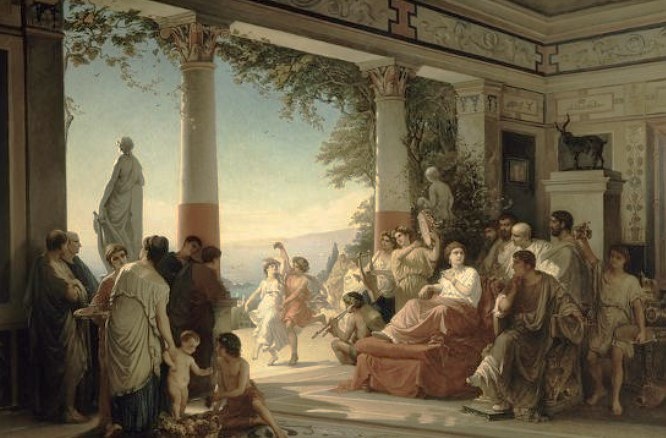
The Empress Livia attending the grape harvest on the hills of Grignano, by Cesare dell'Acqua (1821-1904), oil on canvas, 126x183 cm.
Like all noblewomen of ancient Rome, Livia personally managed the domus, organizing the household servants in their daily tasks. It is believed she employed a great number of them, as suggested by the discovery of two large columbaria nearly seventeen centuries later along the Appian Way. These are considered the largest from the imperial age: Livia’s tomb housed the remains of 550 servants and freedmen, while that of Augustus accommodated as many as 3,000. Like her husband, she protected the most skilled and deserving slaves, granting many their freedom.
In 1726, the Monumentum Libertorum et Servorum Liviae Augustae was fully uncovered. It was located less than 300 meters from Augustus’s own monument, in the Benci vineyard at what is today number 91 on the Appian Way. However, not long after its discovery, the structure was completely destroyed, and the archaeological finds were dispersed across various museums in Europe. The only surviving records are engravings made at the time of its discovery, which document its layout, interior, inscriptions, and tombs. The inscriptions indicate that the columbarium was built in the final years of Augustus’s life and remained in use until the reign of Emperor Claudius.

Excavation work in the Monumentum Liviae (Bianchini, Table 4)
The term columbarium — referring to a specific type of collective tomb in ancient Rome, characterized by rows of small niches along the walls designed to hold funerary urns — was first used to describe the funerary monument of Livia discovered along the Appian Way in 1726. Its earliest recorded usage dates back to 1727, when Francesco Gori officially introduced the term in his work Monumentum sive Columbarium Libertorum et Servorum Liviae Augustae. In fact, in all known Latin inscriptions, this type of burial site is referred to as ossarium, ossuarium, monumentum or sepulchrum, but never as columbarium.
Part of what was discovered in the Monumentum Liviae is preserved in the Capitoline Museums in Rome. These items belonged to the first Albani collection, which was sold in 1736. Among the archaeological finds is an interesting funerary relief depicting an abacus. In 1747, Marchese Giovanni Pietro Lucatelli described it as follows:
"Above this, another bas-relief is placed, depicting a half-naked man lying on a bed, holding a purse in his right hand and an open book in his left, which rests on the knee of a woman seated before him. To the left, a young boy stands, appearing to observe or count coins on a small tablet (abacus). In a medallion seemingly hanging on the wall, a bust is visible. Scholars believe this marble relief represents a dying man making his will, with the medallion containing the image of an ancestor of the testator."
- Museo capitolino, ossia descrizione delle statue, busti, bassirilievi, urne sepolcrali, iscrizioni, ed altre ammirabili, ed erudite antichità, che si custodiscono nel palazzo alla destra del Senatorio vicino alla chiesa d'Araceli in Campidoglio by Marchese Giovanni Pietro Lucatelli, Publication date 1750.
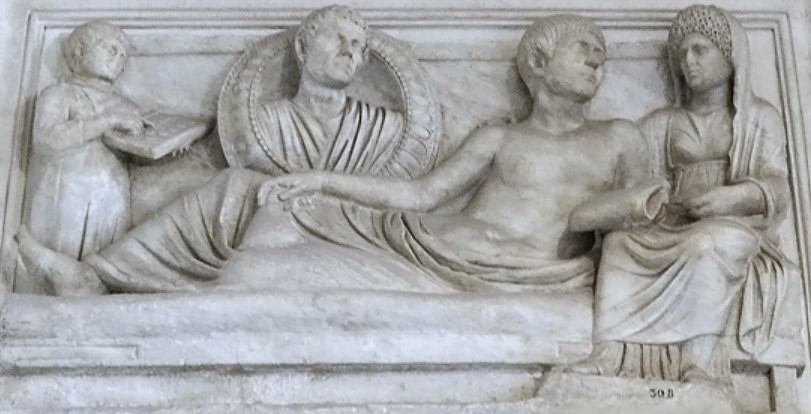
A marble funerary relief discovered in the Monumentum Liviae, Capitoline Museum (Rome)
Today, the relief is understood to be a funerary monument for a young Roman man from the early second century CE. The deceased is shown reclining on a couch beneath a shield-portrait of his deceased father (which may indicate a military background). He holds a scroll in his left hand and a large money bag in his right. His grieving mother, her palla drawn over her elegant Flavian-era hairstyle, is seated on the right, with her arm resting tenderly on her son's shoulder. The slave standing on the left is operating an abacus, symbolizing the family’s success in business.
Capitoline Museum (Rome)